IFC-GPT v2
From a building description to an inspectable 3D model, with planning and checks along the way.
- My contribution
- Agent workflow, IFC generation, validation, API, and browser interface.
- Status
- Public prototype
- Built with
- Python · LangGraph · FastAPI · IfcOpenShell · Next.js
The problem
A building description is a starting point, but it leaves dimensions, geometry, and relationships open to interpretation. For someone exploring a building concept, the useful next step is a model they can inspect, with the assumptions and failures available for review.
IFC-GPT connects that description to IFC, an open format for building information models. The public prototype explores this workflow in the context of Hong Kong Modular Integrated Construction.
My contribution
I authored the public prototype’s code and visual material: the agent workflow, building primitives, validation steps, API, and browser interface. This case study covers that repository. My professional work and contributions to co-developed platforms are described separately in my experience.
The approach
The workflow separates interpretation from geometry. An agent turns the request into a structured building plan. Python functions create walls, slabs, windows, and other elements from that plan. Separate checks inspect the plan and the resulting IFC file before a bounded repair loop and export.
- Describe & clarify
- Structure the plan
- Build IFC geometry
- Check & repair
- Export & inspect
LangGraph coordinates the steps, FastAPI exposes the workflow, and a browser viewer lets the user inspect the file. The representation between planning and building is a useful boundary: the geometry functions can be exercised independently of a model call.
Decisions and tradeoffs
A structured plan before geometry. A schema gives the builder concrete element types, dimensions, storeys, and references. It makes mistakes easier to locate than a single opaque generation step, although a schema alone cannot establish that a design makes sense.
Checks at several levels. The code checks plan relationships, IFC schema, selected property requirements, and semantic conditions. Each layer asks a different question; passing one does not imply that the others pass.
A bounded repair loop. Limiting retries prevents an indefinite loop, but the current export contract still needs work: the graph can export after exhausting its repair budget. A file being downloadable is therefore not evidence that all validation succeeded.
What I verified
On 11 November 2026, the public revision f781ae9 was checked locally. A focused set of 99 tests passed, covering plan checks, build dispatch, walls, slabs, doors, windows, and export behavior. This was a selected regression run, not the complete repository suite or a measure of generated-design quality.
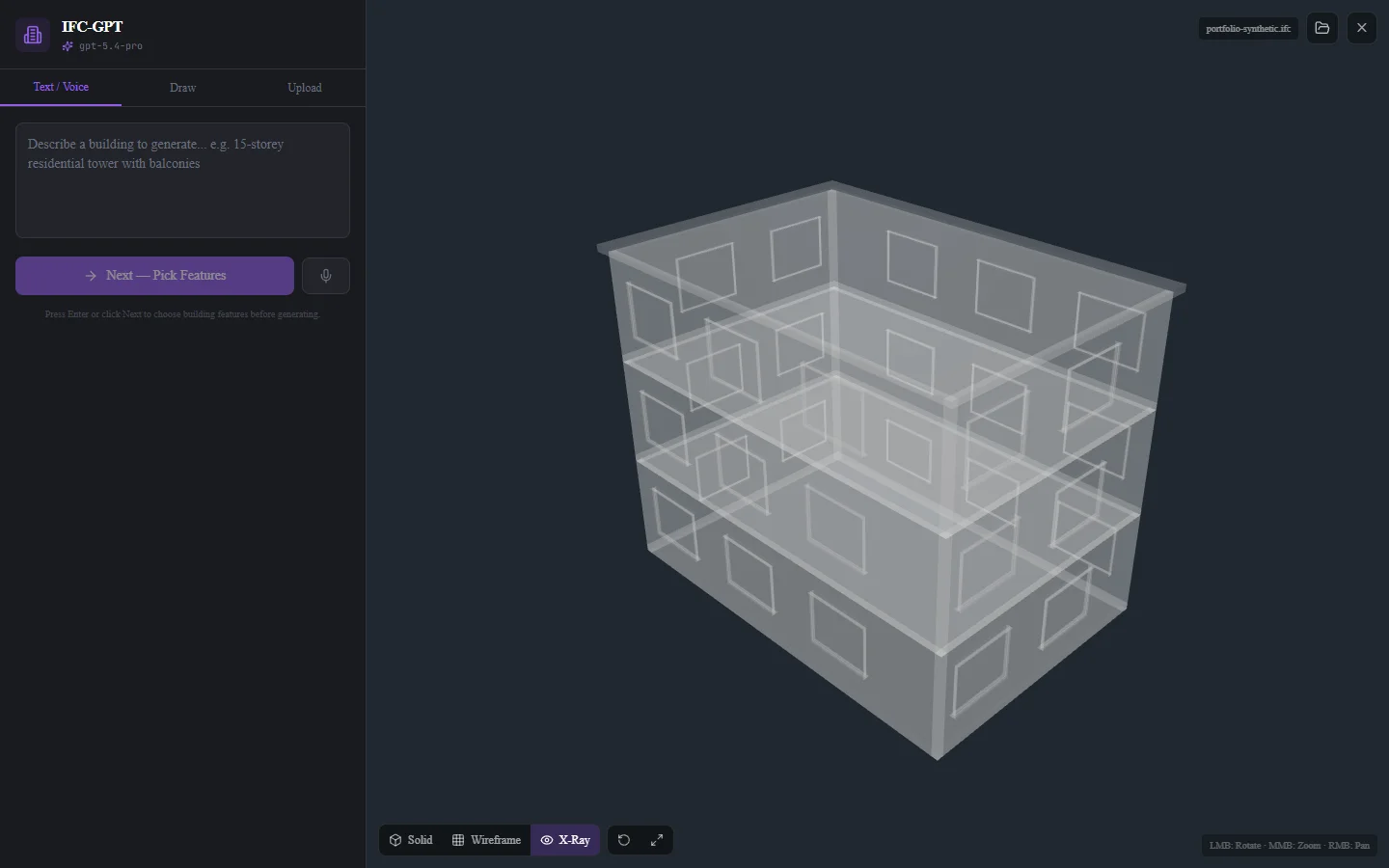
For the screenshot, a self-authored synthetic plan was passed through the real builder. The resulting file contained 3 storeys, 12 walls, 30 windows, and 4 slabs. It opened in the production browser interface; fit, solid, wireframe, and X-Ray controls were exercised without page exceptions. No AI call or employer model was used for this evidence.
The same fixture passed the plan and IFC schema checks but failed one of three included IDS property specifications. The validator also warned that there was no IfcRoof entity: the top surface was a roof slab. The overall validation result was a failure. A visible model is useful evidence of the generation and viewing path, while these results show the limits of treating successful rendering as correctness.
Limitations
- Natural-language generation, voice input, authentication, and repair using a live model were not exercised in this verification. Their presence in the code is not an end-to-end result.
- Modification currently regenerates a model rather than reliably editing one existing element.
- The included property checks do not establish building-code compliance or certification. The specification named “Fire doors must have fire rating” actually checks an
IsExternalproperty, so its label overstates its scope. - The public production build requires Supabase configuration to prerender its authentication pages. This capture used a clearly unused localhost configuration; authentication was not tested. A blank viewer was observed in development mode, while the production build rendered the fixture.
- This is a repository prototype, with no claim of customers, production deployment, or measured business impact.